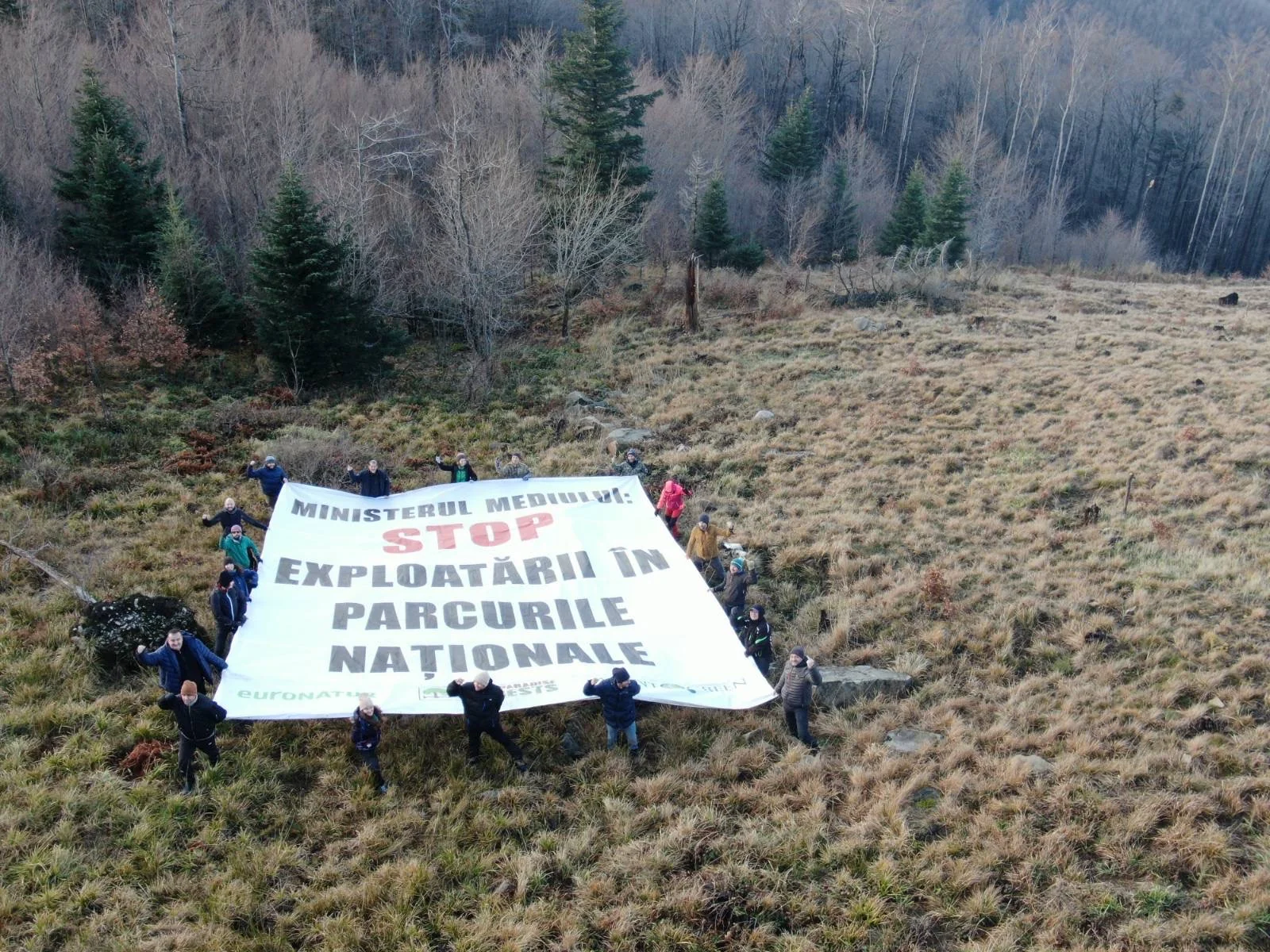
Dozens of major national and international organizations notify the European Commission about the Romanian Environment Ministry’s unprecedented attack on biodiversity
Dozens of major national and international organizations have notified the European Commission about the Romanian Environment Ministry’s unprecedented attack on biodiversity.
In the notification sent yesterday to the leadership of the European Commission’s Directorate-General for Environment, the organizations draw attention to the Romanian Environment Ministry’s proposed amendments to Emergency Ordinance OUG 57/2007, the main act transposing the Habitats Directive in Romania, which the Government could adopt shortly with immediate legal effects.
The proposed new rules make the designation of strict protection areas — renamed “priority areas for biodiversity” — conditional on the explicit consent of landowners or administrators, regardless of whether these areas meet the scientific criteria for strict protection. For priority biodiversity areas outside a protected area, management rights are granted to landowners.
This approach creates a private veto over a public-interest objective and a major risk of a sharply reduced and fragmented protection network, with areas of exceptional ecological value excluded from strict protection. Estimates suggest that approximately 80% of the land identified for strict protection (1.8 million hectares) might not be designated because of the lack of agreement from private owners or administrators (for example, the national forest administration Romsilva and private forestry associations).
A crucial aspect is that the amendments to OUG 57/2007, proposed without consulting the Romanian Academy, would also apply to strict protection areas within already designated Natura 2000 sites, thus probably affecting their integrity. If strict protection areas within a Natura 2000 site do not have the owners’ or administrators’ agreement, the government can no longer implement the mandatory conservation measures required by the Habitats Directive. Applying the new rules would therefore lead to numerous breaches of the Habitats Directive, particularly:
- Article 6(1), which requires the necessary conservation measures to be established;
- Article 6(2), which prohibits habitat deterioration and significant disturbance of species once sites have been designated.
Moreover, relevant CJEU case law establishes that any measurable reduction in the level of protection of Natura 2000 sites may constitute a breach of EU law, and that owners’ opposition cannot justify failure to take the necessary conservation measures.
The Romanian Environment Ministry justifies the proposed changes as necessary to fulfill Romania’s commitments under its National Recovery and Resilience Plan (PNRR), Milestone 13.2, particularly placing at least 10% of the national territory under strict protection in line with the EU Biodiversity Strategy for 2030. Paradoxically, however, the proposed amendments to OUG 57/2007 are expected to produce the opposite result. Credible sources indicate that the designation of strict protection for 10% of the land area is being contested by Romania’s Agriculture Ministry and the political establishment, particularly social democrats seeking to appease their power base, namely local political authorities (mayors, county council presidents, etc.).
During the scientific mapping process to achieve 10% strict protection (an EU-funded project, contract no. 100395787), initial assessments identified approximately 2.3 million hectares as eligible, broadly aligning with Romania’s commitments under PNRR Milestone 13.2. However, repeated and opaque changes to the selection methodology, combined with other political interventions, led to drastic reductions in the areas initially identified. The requirement for an “owner’s agreement” could reduce the final designation to below 500,000–600,000 hectares, representing only 2–3% of Romania’s territory. The resulting area would mainly cover already strictly protected zones within National Parks and unproductive alpine land, leaving extensive valuable and productive primary and old-growth forests fully exposed to commercial exploitation.
Proper implementation of the National Recovery and Resilience Plan (PNRR) requires not only mapping based on scientific criteria but also sustainable financing mechanisms to compensate landowners subject to exploitation restrictions, thus balancing biodiversity conservation with local economic interests — a step the Romanian government has not taken. In 2025, the Environmental Fund Administration (AFM) managed a budget of approximately €3.2 billion (~1% of GDP). Despite this substantial funding, biodiversity spending has been systematically neglected, accounting for only approximately 0.2% of AFM’s total budget.
In view of the situation described, we respectfully ask you to consider issuing an urgent warning to Romania’s Government to prevent the adoption of the proposed amendments to OUG 57/2007 before irreversible legal and ecological damage occurs. We believe swift intervention by the European Commission can still prevent structural non-compliance with EU legislation, with long-term effects on biodiversity protection in Romania.
The signatory organizations and their representatives, in alphabetical order:
Adi Dohotaru, Asociația Societatea Organizată Sustenabil, Romania
Alexandru Teleagă, Asociația Altitudine, Romania
Alina Chiriac, Romanian Environmental Defender
Attila Marton, Mișcarea pentru Transilvania Egalitară, România
Bogdan Stroe, Grupul de Initiativa Civica IOR-Titan, Romania
Camelia Gui, Asociația Clujul Sustenabil, România
Ciprian Galusca, Platforma pentru Adaptare Climatică, Romania
Cristina Lapis, Asociația de Protecție a Animalelor Milioane de Prieteni, România
Claudiu Olenici, Organizația pentru Protecția Mediului și Combaterea Braconajului, Romania
Dan Trifu, Fundația Eco-Civica, Romania
Dorina Milea, AER Muntenia Sud, Romania
Dragoș Tuță Mihaylov, Ambasada Sustenabilității în România
Gabriel Paun, Agent Green, Romania
Gabriela Cotaru, Hosman Durabil, Romania
Hans Hedrich, Verein Neuer Weg, Romania
Mihai Goțiu, România Curată, Verde Curat, Romania
Mihai Constantinescu, Asociația Natura Transilvania, Romania
Roxana Pencea Brădățan, Declic, Romania
Valentin Sălăgeanu, Greenpeace CEE Romania
Viktoria Luft, Federația Peisaj Deschis, Romania
Almuth Ernsting, Biofuelwatch, Europe/USA
Artur Milewski, Forests NOW, Poland
Comité Schone Lucht, Netherlands
Evelyn Schoenheit, Forum Ökologie & Papier, Germany
Farištamo Eller, Save Estonia’s Forests
Focus Association for Sustainable Development, Slovenia
Ines Gavrilut, Bruno Manser Fonds, Switzerland
International Commission for the Protection of the Alps
Jana Ballenthien, ROBIN WOOD, Germany
Hannah Mowat, Fern, EU
Hermann Edelmann, Pro REGENWALD, Germany
Maarten Visschers, Leefmilieu, Netherlands
Lina Burnelius, Protect the Forest, Sweden
Dr. Lutz Fähser, Forester and Scientist, Germany
REVIVO, Institute for ichthyological and ecological research
Sergiy Moroz, European Environmental Bureau (EEB), EU
Umanotera, The Slovenian Foundation for Sustainable Development
Zoe Lujic, Earth Thrive, UK/Serbia and Balkan Centre for the Rights of Nature, Serbia/Balkans
Annexes:
Technical briefing by Agent Green, Declic, Greenpeace and PAC, Romania:
https://www.greenpeace.org/static/planet4-romania-stateless/2026/01/e7210cdf-fisa-tehnica-10.pdf
Press release by Agent Green, Declic, Greenpeace and PAC, Romania:
/ministerul-mediului-incalca-legea-si-blocheaza-protectia-naturii
Technical annex: amendments to OUG no. 57/2007 to the communication on the major risk of failure to comply with the PNRR milestone and the “Do No Significant Harm” (DNSH) principle arising from the draft Emergency Ordinance amending and supplementing OUG no. 57/2007 on the regime of protected natural areas in Romania (attached).
Related articles
The Ministry of Environment is breaking the law and blocking nature protection
Domogled is burning, the state is late and the environment ministry wants to “sanitise” Romania’s forests