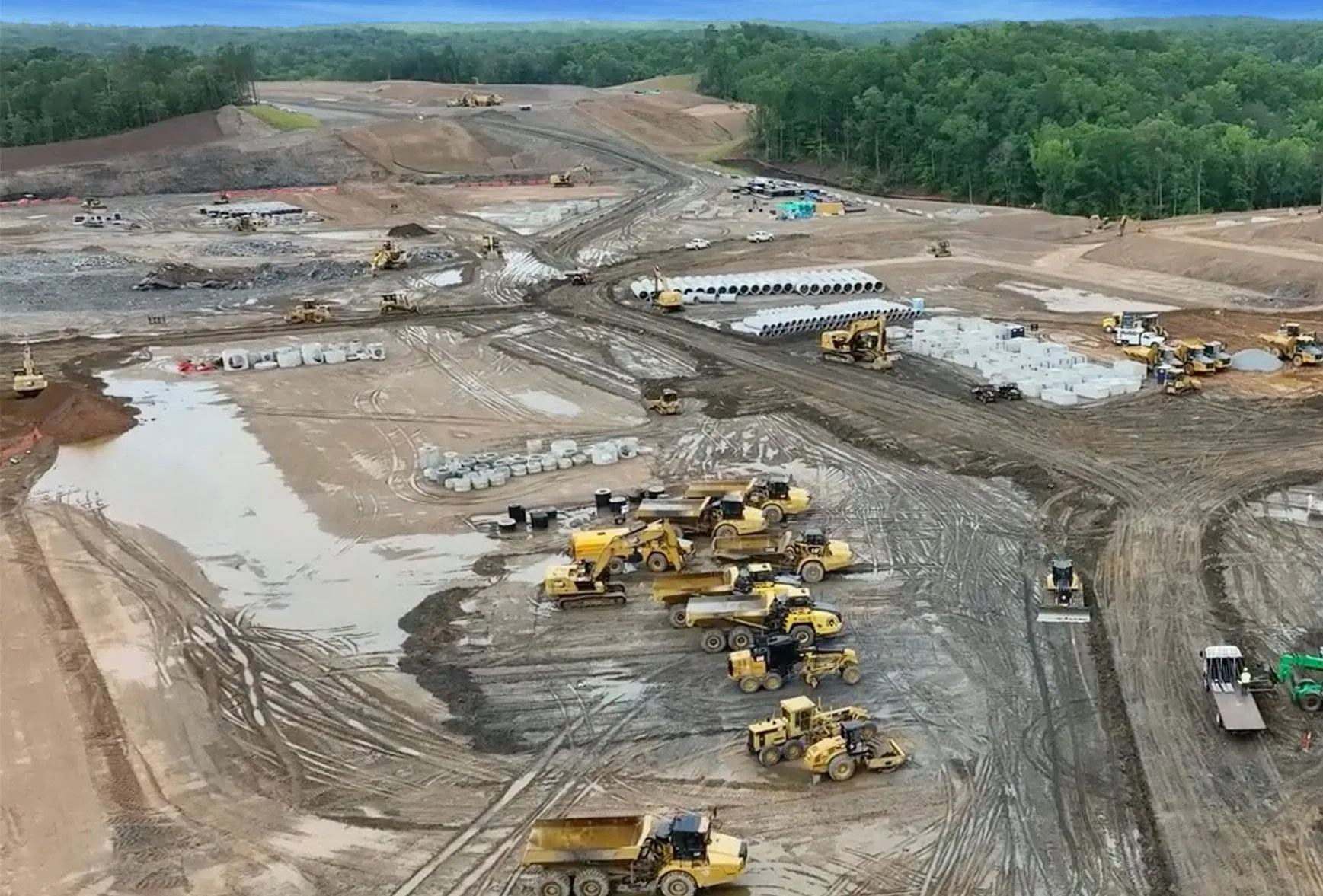
The cloud does not float. It has foundations of concrete, steel, cables, transformers, batteries, generators, cooling equipment and servers that run without stopping. It consumes land, energy and water, produces heat and electronic waste, and can require massive investment in local electricity grids.
Artificial intelligence can bring significant benefits to society. But there is nothing intelligent about building digital infrastructure by sacrificing nature, draining water resources or transferring costs to communities.
Agent Green’s position: Agent Green does not oppose data centres or the development of artificial intelligence. We oppose projects that are poorly located, publicly promoted before they are documented, and authorised without demonstrating compatibility with ecological limits, the energy transition and communities’ interests.
of electricity consumed
by data centres worldwide in 2024
estimated consumption in 2030
International Energy Agency
maximum theoretical annual consumption
the 80 MW project announced in Luna, Cluj
Why this campaign is needed
Data centres consumed approximately 415 TWh of electricity worldwide in 2024. The International Energy Agency estimates that this consumption could double by 2030, reaching approximately 945 TWh. The problem is not just the global quantity, but the concentration of enormous consumers at particular points on the grid, where bottlenecks, expensive investment and a return to polluting energy sources may result.
Europe has begun requiring reporting of energy performance and water footprint for data centres with an installed IT equipment power demand of at least 500 kW. The European Union is also developing a common rating scheme and minimum performance standards for this sector.
These rules are necessary, but insufficient. Romania needs public policy before projects are authorised one by one without a vision of their cumulative effects on energy, water, land, biodiversity and communities.
Agent Green’s campaign seeks clear conditions for every new data centre and for the expansion of existing ones.
The campaign’s principles
1
Natural and agricultural land is neither wasteland nor empty space
New data centres must prioritise abandoned industrial sites, former production facilities, closed quarries or mines, contaminated land and other areas already converted to artificial surfaces.
Forests, pastures, wetlands, floodplains, semi-natural land and productive agricultural soils must not be converted into digital infrastructure when alternatives exist on degraded land. Even abandoned industrial sites must first be checked, because some have since developed valuable habitats or may require decontamination.
The first question must not be “how do we build here?”, but “why here, and what alternatives were assessed?”.
2
Energy must be additional, clean and available in real time
A power purchase agreement or a few “green” certificates do not demonstrate that a data centre actually runs on clean energy every hour.
The investor must present the energy source, hourly consumption profile, new generation and storage capacity it finances, effects on the grid, and how it operates when the sun does not shine and the wind does not blow.
New data centres must contribute to additional solar and wind generation, storage, flexibility and grid modernisation. The costs of connection and infrastructure reinforcement must not be transferred to households and small businesses.
Data centres must not become a pretext for new gas or coal power plants, burning forests under the biomass label, destroying rivers with hydropower plants or reviving expensive, slow energy megaprojects.
3
Efficiency must be demonstrated, rather than declared
Every project must publish its installed IT capacity, estimated total annual consumption, load curve, cooling-system efficiency and recognised European indicators, including PUE, WUE and renewable-energy consumption.
A good PUE alone does not prove a project is sustainable. A highly efficient centre may still consume an enormous total amount. Both efficiency and the absolute scale of impact must be assessed.
Operators must also demonstrate that they use installed capacity efficiently, extend equipment lifetimes, choose efficient hardware and software, and can shift non-urgent workloads to hours when renewable energy is available.
4
Water must be budgeted down to the last cubic metre
The phrase “closed loop” does not mean zero water consumption and does not, by itself, answer questions about cooling.
Every project must publish annual water consumption and withdrawal, sources used, losses, demand on very hot days, indirect impacts associated with energy generation and how the facility operates during drought.
The permit must include binding limits, public monitoring and a plan to reduce or stop non-essential consumption when public water supplies, agriculture or ecosystem functioning are threatened.
Drinking water must not be used for cooling where safe technical alternatives exist. No data centre may take precedence over communities’ right to water and the ecological flows rivers need.
5
Waste heat must be recovered
Almost all electricity used by servers eventually becomes heat. Building a centre underground does not make this heat disappear. Soil and rock cannot absorb tens of megawatts of heat indefinitely.
For data centres above 1 MW, European legislation requires a cost-benefit analysis of waste-heat use. Agent Green believes heat recovery must become a condition of authorisation, except where an independent assessment demonstrates that no feasible use exists.
Heat can be used in local networks, greenhouses, public buildings, homes, industrial processes, drying facilities and other productive activities. Promises of recovery must be backed by contracts, infrastructure and identified consumers, rather than just a green arrow in a presentation.
6
The community must be consulted before the decision is made
Consultation must not be organised after land has been selected, contracts signed and a publicity campaign launched. At that point, the public is merely being asked to validate a decision already taken.
From the concept stage, the community must receive information about land, energy, water, noise, traffic, generators, risks, infrastructure, permanent jobs, local revenues and public costs.
The authorities must publish every contract involving public land or money. The investor must answer questions from the community, experts and environmental organisations before essential approvals are issued.
7
Cumulative effects must be assessed
A data centre cannot be assessed as an isolated building. Assessment must include power lines, substations, pipes, roads, water withdrawals, cooling systems, batteries, backup generators and foreseeable expansions.
The cumulative impact alongside other data centres, industrial projects, irrigation, settlements and energy consumers in the same region must also be analysed.
Splitting a campus into multiple phases, buildings or permits must not be used to artificially diminish its real impact.
8
Design must account for the climate crisis
Studies based exclusively on historical data are no longer sufficient. Projects must be assessed for longer droughts, higher temperatures, heatwaves, torrential rainfall, floods, landslides and fires.
A centre built beside a river or above an aquifer must present hydrogeological studies, flood scenarios, excavation impacts and measures applicable throughout its operational lifetime.
Infrastructure resilience cannot be achieved by making surrounding communities and ecosystems more vulnerable.
9
The entire material footprint must be calculated
Assessment does not stop at electricity consumption. It must include emissions from concrete and steel, raw-material extraction, equipment manufacturing and transport, refrigerants, batteries, generators and electronic waste.
The operator must have a plan to repair, reuse and recycle equipment, as well as a financial guarantee for decommissioning the facility and restoring the site.
A building abandoned when the servers’ commercial lifespan expires is not innovation, but the next environmental problem left to the community.
10
Transparency must continue after opening
Data on energy, water, recovered heat, emissions, efficiency and incidents must be published annually in a verifiable, comparable format.
For large projects, monitoring must also be carried out by an independent entity. The authorities and community must be able to verify whether promises made during authorisation are kept during operation.
Commercial confidentiality cannot conceal essential information about natural-resource use, pollution, emissions or risks to health and the environment.
Agent Green’s red lines
-
✗
Agent Green opposes projects occupying forests, pastures, wetlands, floodplains, natural habitats or productive agricultural soils without genuinely assessing alternatives.
-
✗
We oppose projects that do not transparently disclose their energy and water sources, push the energy system towards fossil fuels, transfer grid-connection costs to the public or treat heat recovery as a publicity option.
-
✗
We oppose fragmented permitting, superficial assessments, token consultations and claims such as “green”, “water-free” or “zero emissions” that are not supported by verifiable data.
We will use every available administrative, scientific and legal avenue when nature and communities are presented with a fait accompli.
What we ask of the Government and authorities
-
✓
Romania needs a national strategy for locating data centres, subject to strategic environmental assessment. It must identify available industrial land, grid capacity, sustainable water sources, potential heat users and areas that must be excluded.
-
✓
We call for a public register of data centres, with information about owners, beneficiaries, capacity, energy and water consumption, supply sources, recovered heat, backup generators and the performance indicators required by European rules.
-
✓
We call for binding minimum conditions on location, efficiency, additional energy, water consumption, heat recovery, transparency, decommissioning and community protection.
-
✓
No state aid, public land, tax incentive or preferential grid connection should be granted before these criteria are met.
The project announced in Luna commune, Cluj county, prompted Agent Green to turn a specific response into a national campaign.
According to publicly presented information, the project would have a capacity of approximately 80 MW and would be built underground on former pasture near the Arieș River. If it operated continuously at this power, its theoretical maximum consumption would reach approximately 700.8 GWh per year.
The investor mentioned a closed-loop liquid-cooling system but has not yet published all the necessary data on energy, water, heat discharge and recovery, hydrogeology, flood risk, cumulative impact and long-term community benefits.
Agent Green did not oppose the investment in principle. We asked for the land, technology and project impacts to be analysed transparently before political and commercial promotion turns the project into a fait accompli.
Luna is more than the name of a project. It is the first test of how Romania will decide whether digital infrastructure develops within ecological limits or outside them.
Read the PressOne article about the project →
What Agent Green will do
We will monitor new projects and expansions of existing centres, request permitting documents, analyse impacts on land, energy, water and biodiversity, and inform affected communities.
We will propose national standards, participate in consultation procedures and notify the Romanian authorities and European institutions when legislation or the public interest is ignored.
We will collaborate with researchers, engineers, energy and water specialists, communities and investors who accept transparency and seek real solutions.
Dialogue is possible before destruction. After destruction, the courts remain.
Help us see projects before it is too late
If a data centre is planned in your community, send us public notices, local decisions, urban plans, approvals, photographs and the site coordinates.
Send information to office@agentgreen.org
Digital infrastructure can be part of the future. Nature, water and communities must not become that future’s hidden bill.
There is no cloud without ground.
And the Earth has limits.
Cover photo: Switch — construction site of The Keep 2.0 data-centre campus, North Atlanta, Georgia, USA.