The letter on national parks that Minister Tanczos Barna refuses to answer
Bucharest, 12 January 2021
TO: Environment Ministry
Address: Bvd. Libertăţii No. 12, Sector 5, Bucharest
FOR THE ATTENTION OF: Tanczos BARNA, Minister
Request to align Romania’s national parks with IUCN principles
Dear Mr Tanczos BARNA,
We congratulate you on the challenge you accepted by taking charge of the Environment Ministry. We wish you success in your work and offer our expertise in biodiversity and climate change.
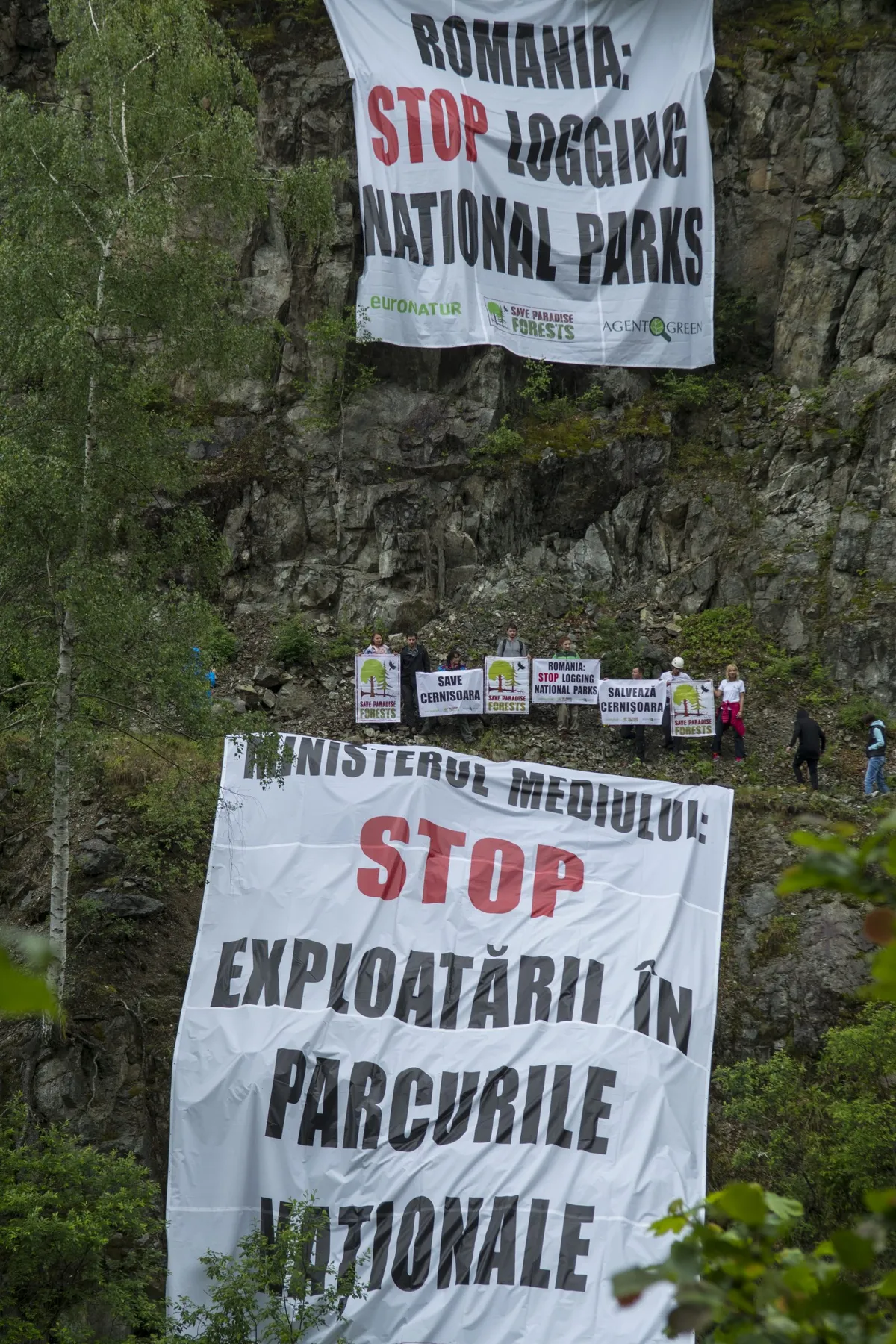
To begin the dialogue between Agent Green and you, we would like to draw your attention to the state of national parks, a problem your predecessors left unresolved despite their promises. These are the most precious protected natural areas, covering only 1.33% of Romania, with their forests covering only 0.99% of Romania. Although IUCN’s international principles do not permit logging in national parks, with minor exceptions for local communities’ benefit, industrial logging in Romania harms biodiversity, tourism and local communities. Yet Romania, through the Environment Ministry, is an IUCN member country, and it is time to respect the international principles it endorsed.
Since Romsilva took over national-park administration, the parks have been logged industrially, with at least 1.2 million cubic metres extracted in the period 2014-2018 alone, as follows:
NP Domogled Valea-Cernei – 280,000 cubic metres
NP Semenic Cheile-Carașului – 240,000 cubic metres
NP Călimani – 190,000 cubic metres
NP Ceahlău – 130,000 cubic metres
NP Munții Rodnei – 100,000 cubic metres
NP Cheile Nerei-Beușnița – 83,000 cubic metres
NP Cozia – 60,000 cubic metres
NP Piatra Craiului – 50,000
NP Munții Măcin – 40,000 cubic metres
NP Retezat – 15,000 cubic metres
NP Buila Vânturarița – 13,000 cubic metres
NP Defileul Jiului – 8,000 cubic metres
NP Cheile Bicazului – 7,000 cubic metres
Estimated total volume harvested from national parks – 1.216 million cubic metres
Agent Green investigated and published reports on the current situation in 5 of the 13 national parks, as follows:
Domogled – Valea Cernei National Park
Semenic – Cheile Carașului National Park
Cheile Nerei – Beușnița National Park
Munții Călimani National Park
Munții Rodnei National Park
We hope this information will help persuade you to take swift, concrete measures to improve the situation in national parks. At the end of this letter, we summarise specific proposals that we hope to discuss in a direct meeting as soon as possible. We therefore ask you to grant us an online video meeting on this subject at the earliest opportunity.
We also present some relevant information on this subject. The situation currently stands as follows:
• Logging takes precedence over protection and conservation. Large-scale commercial logging serves major companies, while local communities do not have enough wood even for heating
• Logging takes place even in virgin, centuries-old and naturally structured forests within national parks
• Romania’s national parks do not follow international scientific recommendations (IUCN), either in their central non-intervention areas, which are too small and scattered, or in their buffer zones, where large-scale commercial logging takes place
The Romanian Carpathians are in a markedly inferior state of degradation compared with before becoming national parks. In practice, current national-park management plans are really plans for exploiting and systematically degrading intact forest ecosystems. In parks without approved management plans, there is total chaos. Logging even takes place in nature reserves within national parks.
WHAT ARE NATIONAL PARKS IN ROMANIA IN THEORY?
• National Parks are protected natural areas whose objectives are to protect and conserve territories representative of the national biogeographical space, encompassing natural features of outstanding physical-geographical, floristic, faunal, hydrological, geological, palaeontological, speleological, soil-related or other value, while allowing visits for scientific, educational, recreational and tourist purposes.
• National-park management should maintain the physical-geographical environment in its natural state, protect ecosystems, conserve genetic resources and biological diversity under conditions of ecological stability, and prevent and exclude all forms of natural-resource exploitation and land uses incompatible with the assigned purpose. Within national parks, only traditional activities practised by communities in the national-park area are allowed, and these activities are to be regulated by the management plan.
• National parks correspond to IUCN category II, “National park: protected area managed mainly for ecosystem protection and recreation”.
*Extract from Emergency Ordinance 25/2007
WHAT IS IUCN, AND WHAT DOES IT RECOMMEND TO THE WORLD’S STATES ABOUT NATIONAL PARKS?
• IUCN (International Union for Conservation of Nature) is an international organisation founded in October 1948, dedicated to conserving natural resources in 1948, and headquartered in Gland, Switzerland, on Lake Geneva. IUCN brings together 83 states, 108 government agencies, 766 non-governmental organisations and around 10,000 experts and scientists from countries worldwide.
• IUCN is the best-known protected-area classification system, partially adopted with modifications in Romania too. Following discussions and consultations in this field, six protected-area categories were established in the ‘90s and are currently valid worldwide:
1. Category Ia – strict nature reserve (scientific reserve in Romania)
Category Ib – wilderness area (this category does not exist in Romania)
2. Category II – national park (same in Romania)
3. Category III – outstanding natural monument (natural monument)
4. Category IV – habitat/species management area (nature reserve in Romania)
5. Category V – protected landscape/seascape (nature park in Romania)
6. Category VI – protected area with sustainable use of natural resources (this category does not exist in Romania)
Category II: National park
Definition: Category II protected areas are large natural or near-natural areas established to protect large-scale ecological processes, together with the species and ecosystems characteristic of the area, which also provide a foundation for environmentally and culturally compatible spiritual, scientific, educational, recreational or tourist visits.
Primary objective
• To protect natural biodiversity together with its underlying ecological structure and supporting environmental processes, and to promote education and recreation.
Other objectives:
• To manage the area to perpetuate, in as natural a state as possible, representative examples of physiographic regions, biotic communities, genetic resources and unimpaired natural processes;
• To maintain viable and ecologically functional populations and assemblages of native species at densities sufficient to conserve ecosystem integrity and long-term resilience;
• To contribute particularly to conserving wide-ranging species, regional ecological processes and migration routes;
• To manage visitor use for inspirational, educational, cultural and recreational purposes at a level that will not cause significant biological or ecological degradation of natural resources;
• To take account of the needs of indigenous people and local communities, including subsistence resource use, insofar as this will not adversely affect the primary management objective;
• To contribute to local economies through tourism.
• Distinctive features: Category II areas are usually large and conserve a functioning “ecosystem”, although this may require the protected area to be complemented by appropriate management of surrounding areas.
• The area should contain representative examples of major natural regions and biological, environmental or landscape features where native plant and animal species, habitats and geodiversity sites have particular spiritual, scientific, educational, recreational or tourist significance.
• The area must be of sufficient size and ecological quality to maintain the ecological functions and processes that allow native species and communities to persist over the long term with minimal management intervention.
• The composition, structure and function of biodiversity should largely be in a “natural” state or have the potential to return to it, with a relatively low risk of invasion by non-native species.
APPLYING THE IUCN PROTECTED-AREA CATEGORIES
The primary management objective should be applicable to at least three quarters of the protected area.
The primary objective must apply to at least three quarters of the protected area – the 75 percent RULE: many protected areas may contain specific zones where other uses are permitted, for example:
• Tourist lodges and campsites in category II national parks, as in many protected areas in the African savannahs;
• Villages remaining within strictly protected areas, for example a village within Cat Tien National Park in Vietnam;
• Small fully and strictly protected areas within what is a managed category V cultural landscape, for example the National Trust’s woodlands in Brecon Beacons National Park, Wales, United Kingdom;
• Areas where fishing is permitted within otherwise strictly protected marine or freshwater areas, for example Kosi Bay Nature Reserve in KwaZulu Natal, South Africa.
IUCN recognises these cases and recommends that up to 25 percent of the land or water in a protected area may be managed for other purposes, provided these are compatible with the protected area’s primary objective. In some cases, those 25 percent may shift: for example, Bwindi Impenetrable Forest National Park in Uganda allows local communities to gather medicinal plants and other non-timber forest products in specially designated zones that change from time to time so species are not collected too intensively.
GENERAL CONCLUSIONS ON NATIONAL PARKS
• Commercial logging is incompatible with and not permitted in category II national parks.
• Only interventions at the park edge, not to be understood as logging, are permitted to prevent or combat diseases in forest ecosystems that may spread into private forests.
• In the event of natural disasters or infestations, no human interventions are carried out because nature knows best how to protect itself and evolve naturally. Human interventions most often create new ecosystem imbalances.
• In all developed or underdeveloped countries, national parks are a source of pride and drive tourism development, with an important financial contribution to local and regional communities.
• In most countries, national parks serve to protect natural resources in their entirety, and commercial logging is prohibited.
WHAT IS HAPPENING IN ROMANIA’S NATIONAL PARKS?
• A total of 13 national parks of national interest have been designated, occupying 1.33% of the country’s area and 3.31% of its forested area: Călimani, Cheile Bicazului – Hășmaș, Munții Rodnei, Piatra Craiului, Cozia, Buila Vânturarița, Retezat, Defileul Jiului, Domogled – Valea Cernei, Semenic – Cheile Carașului, Nera – Beușnița, Ceahlău and Munții Măcinului. Of these, Cozia is the most forested park, while Retezat has the smallest forest area, with more than half consisting of alpine meadows and glacial areas. Forests in Romania’s national parks cover a total of 233,892.78 hectares, or 0.99% of the country’s area. Only one national park (Defileul Jiului) is managed as a national park by applying the primary objective to at least 75% of its area, in accordance with national legislation and the IUCN management category.
• All national parks show a trend of accelerating ecosystem degradation, felling of virgin and old-growth forests, habitat fragmentation and soil erosion.
• In most national parks, the urbanisation of certain areas for buildings, roads and networks has been expanded and legalised.
• Commercial logging takes place even in reserves in several parks.
• Non-intervention zones cover around 50% of a park’s area, are scattered and do not form a core area. They generally include rocky areas, young forests and meadows, and exclude virgin and old-growth forests so these can be logged.
• Management plans and internal zoning were drawn up under the influence, pressure and decisions of RNP Romsilva officials with an interest in logging (for example Domogled-Valea Cernei and Cheile Nerei-Beușnița National Parks), or under the influence of private landowners such as the Carpathia Foundation (for example Piatra Craiului National Park).
• In a few parks, the administrators themselves (RNP-Romsilva) initiated efforts to abolish or relocate reserves within national parks.
• National-park administrations are economic operators (autonomous public enterprises) whose main activity is: 0210 Silviculture and other forestry activities.
• The administrations are underfunded, lack national coordination, follow inconsistent practices and are inefficient in conservation and resource use.
• Endorsement or visitor fees are charged arbitrarily/differently, affecting competition among economic operators in the parks.
• The administrations’ activities lack transparency and are abusive in many cases.
• National-park and reserve boundaries were drawn or changed according to economic and political interests rather than scientific criteria.
• Local communities do not benefit from commercially harvested timber, which mostly goes to foreign processing companies that, over the past 15 years, have developed processing capacities exceeding the legally harvestable volume nationwide
• Numerous areas of Romania could scientifically have been designated national parks (Țarcu Mountains, Făgăraș Mountains, etc.), yet they are not even considered. The Environment Ministry rejects the scientific designation proposals on political grounds, although the Romanian Academy endorsed them.
Minister, we ask you to take urgent measures to:
• Apply the primary non-intervention purpose and objective in accordance with national legislation and the criteria and recommendations of the International Union for Conservation of Nature (IUCN)
• Transfer unified and effective administration of all national parks to the State within ANANP (National Agency for Natural Protected Areas)
• Restructure ANANP and engage a team of natural-science experts, rather than logging specialists as at present
• Fund national-park administration from the State budget, in accordance with Emergency Ordinance 57/2007, Art. 30 (2)
• Adjust national-park boundaries on scientific grounds to include adjacent virgin/primary and centuries-old forests or entire ecosystems (for example Coșava Mică in Semenic, Câmpușel in Retezat and many others)
• Computerise protected-area administration and management through the SINCRON application
• Restructure Scientific Councils so they consist exclusively of independent researchers and university staff with moral integrity
• Identify funding sources for the Romanian State to purchase private land within national parks where owners voluntarily wish to sell
• Provide compensation for private owners of forests and meadows within national parks
• Incorporate the IUCN categories into national legislation as formulated, together with other recommendations of international organisations
• Establish new national parks (for example Giumalău – Rarău National Park, Munții Ciucaș National Park, Munții Făgăraș National Park and Munții Țarcu National Park)
Minister, we would also like to point out that the EU’s new biodiversity strategy contains provisions supporting our requests to establish new strictly protected national parks: namely, 30% of the country’s area should be Natura 2000 and 10% strictly protected. Romania still has 8% of its forests, or 2.3% of the country’s area, as primary and old-growth forests whose trees, according to forest-management plans, have average ages exceeding 120 years. This would represent approximately 2.8% of the country’s area and includes almost all existing Natura 2000 sites.
Please consider the issues and requests we have raised. We await your response regarding these issues and our meeting request in writing, electronically at office@agentgreen.org, within the statutory deadline.
I assure you of our full availability to provide any necessary clarification, and I remain at your disposal for a direct working meeting with your team.
Yours sincerely,
Gabriel PĂUN
President of Agent Green