
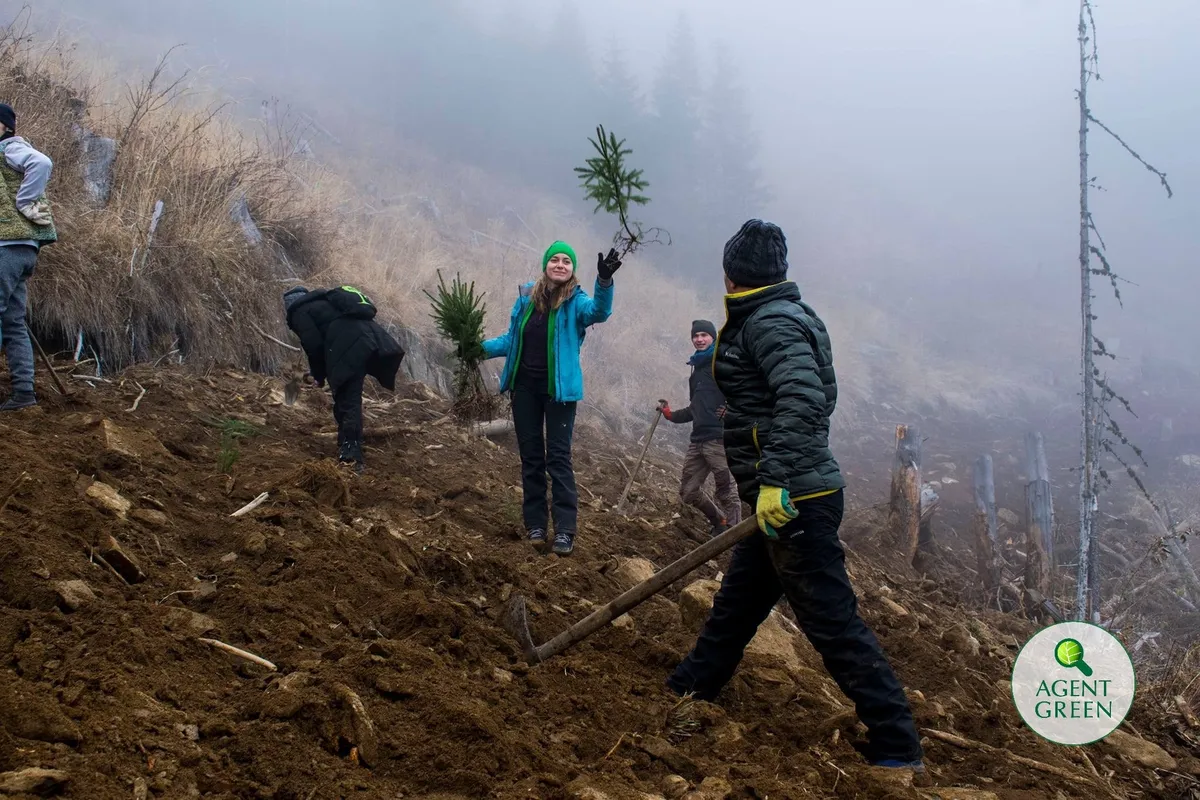
Agent Green analysis of the PNRR funding guides for afforestation and reforestation submitted to public consultation by the Environment Ministry
1. Sub-investment I.1.A “SUPPORT FOR INVESTMENTS IN NEW AREAS COVERED BY FORESTS” — financial allocation of 500 million euros
The scheme allows the establishment of the following types of forest plantations:
- a) forest blocks (min. 0.5 ha);
- b) protective forest shelterbelts (min. 0.1 ha).
OBSERVATIONS (+):
- The aid scheme is well digitalised: of the 16 stages to be completed, 11 take place online in a computer application.
- The following can be accepted as land suitable for afforestation: productive agricultural land, land degraded by physical and chemical processes, and land within built-up areas.
- The deadline for completing the verification of an application is estimated at a maximum of 30 days from registration.
- There are no selection criteria for eligible applications. The session will be a continuous open call for all eligible applicants, on a “first come, first served” basis within the maximum eligible budget allocated, until the total financial allocation is exhausted.
- Undertakings in financial difficulty, as defined in the EU Guidelines, are ineligible. Entities or individuals who have previously committed state-aid fraud are also ineligible.
- Associations, foundations and individuals may be beneficiaries.
- There is no obligation to change the land-use category.
- The establishment of short-rotation plantations of forest tree species, plantations of fast-growing trees used for energy production, or Christmas-tree plantations is ineligible.
- Forest saplings must come from certified sources.
- Support also covers land-preparation work carried out before the actual planting, and losses of agricultural income on productive agricultural land are covered for a period of 12 years.
- We consider the standard cost amounts, excluding the loss of agricultural income, to be up to date and attractive to service providers at present.
- Continued financing from the Environment Fund is ensured for any delayed contracts still underway on 30 June 2026, under which at least the plantation-establishment work has been carried out.
OBSERVATIONS (-):
- The guide mentions over 20 separate documents that may be used during the scheme’s stages, which seems a lot to us, since some actually involve complex documentation that subjects beneficiaries to the stress of bureaucratic formalities.
The requirements by type of beneficiary are as follows:
Individuals: 9–10 documents.
PFA, II, IF (self-employed persons, individual enterprises, family enterprises): 11–13 documents.
Associations without legal personality: 10 documents.
Private legal entities: 14 documents.
Public legal entities: 12 documents.
- Setting the minimum area of a forest block at 0.5 ha is discriminatory towards landholders who do not meet this condition and cannot form associations either.
- Compliance is required with the technical standards on compositions, layouts and technologies for forest regeneration and afforestation of degraded land, approved by Order of the Minister of Waters, Forests and Environmental Protection No. 1648 of 31 October 2000, and with the technical guidance on forest shelterbelts, OM636/2002. This condition curbs the designer’s creativity and the owner’s needs, and even subordinates them to the forest guards’ vision when unprecedented situations arise.
- It makes no sense for the designer, who is a certified specialist, to seek consultation (preliminary endorsement) from the forest guard, as recommended in the guide.
- The standard cost set at just 190 euros/ha annually for lost agricultural income could discourage holders of land offering high agricultural yields.
- We found nothing in favour of establishing a new directorate with 50 employees devoted exclusively to supervising these funds. Only subsection 1.4 of the guide vaguely describes stage No. 9, “the conduct of procedures for evaluating the support application by MMAP”.
- The beneficiary is required to maintain the plantation for only a minimum period of 20 years. In our opinion, the beneficiary should be obliged to register the land in the national forest estate after no more than 10 years if a viable forest has become established on it.
- It is not specified whether or how the new forests’ plant-health status will be monitored or how they will be guarded.
- Partial or total coverage of losses caused by biotic or abiotic factors is funded, the distinction being whether the proportion of the area affected is below or above 80%. We list this as a negative observation because it may create a temptation to commit fraud.
- Delaying the session’s opening date shortens the submission period, which is set to end when the PNRR target is reached, but no later than 28 February 2026.
2. Sub-investment I.1.B: “SUPPORT FOR RESTORING FOREST POTENTIAL AFFECTED BY FIRES, ADVERSE WEATHER EVENTS THAT CAN BE EQUATED WITH A NATURAL DISASTER, PLANT INFESTATIONS BY HARMFUL ORGANISMS AND CATASTROPHIC EVENTS” — financial allocation of 100 million euros.
The aid scheme is aimed at forest-land owners, regardless of ownership type, who have suffered losses caused by biotic and abiotic factors.
OBSERVATIONS (+):
- The main stated objective is to restore the forest potential of areas affected by fires, natural-disaster events, catastrophes and tree infestations by harmful organisms.
- Restoring the forest and resuming ecosystem services will contribute to mitigating climate-change impacts, increasing the amount of carbon stored, conserving biodiversity, restoring habitats, managing forests sustainably and efficiently fulfilling protective functions.
- Use of species characteristic of the natural fundamental forest types is required, which will lead to resilient forests.
- The session will be a continuous open call for all eligible applicants, on a “first come, first served” basis within the maximum eligible budget allocated, until the total financial allocation is exhausted.
- The deadline for completing the verification of an application is estimated at a maximum of 30 days from registration.
- Continued financing from the Environment Fund is ensured for any delayed contracts still underway on 30 June 2026, under which at least the plantation-establishment work has been carried out.
- Associations, foundations and individuals may be beneficiaries.
- The establishment of short-rotation plantations of forest tree species, plantations of fast-growing trees used for energy production, or Christmas-tree plantations is ineligible.
- Undertakings in financial difficulty, as defined in the EU Guidelines, are ineligible. Entities or individuals who have previously committed state-aid fraud are also ineligible.
- Forest saplings must come from certified sources.
- The forest must be retained until it reaches harvesting age, which we hope will be increased when the legislation is amended.
OBSERVATIONS (-):
- A discriminatory condition: limiting the minimum area to 0.5 ha. Under the Forest Code, areas starting at 0.25 ha are considered forests.
- Reforestation of areas affected by illegal logging is funded. See the definition of a catastrophic event in subsection 1.3, point e), and subsection 3.1.3, “eligibility conditions”.
- Holders and administrators who mismanage the forest estate, with illegal logging and other offences against the forestry regime, are eligible.
- Partial or total coverage of losses caused by biotic or abiotic factors is funded, the distinction being whether the proportion of the area affected is below or above 80%. We list this under (-) because it may create a temptation to commit fraud. Neither permanent guarding nor continuous monitoring of plant health is provided for.
- Extremely limited digitalisation. There is no computer application. The 14 implementation stages follow traditional procedures involving preparation, presentation, design, registration, application, endorsement, measurement, notification, signing, identification, inspection, authorisation and acceptance of work.
- No standard costs are provided for.
- The guide does not clarify whether funds from the national conservation and regeneration fund provided for in Article 33 of the Forest Code can also be used for the same area covered by a PNRR funding contract.
- The guide mentions over 25 separate documents that may be used during the scheme’s stages, which seems a lot to me, since some actually involve complex documentation that exposes those involved to the stress of such unnecessary bureaucratic formalities.
The requirements by type of beneficiary are as follows:
-Individuals: 6–7 documents.
-PFA, II, IF: 8–10 documents.
-Private-law legal entities: 11 documents.
-Public legal entities, UAT (territorial administrative units) and autonomous public enterprises: 9 documents each.
In conclusion, we consider the two guides to be well-structured, intelligible technical information materials that we expect will be able to fulfil their role in facilitating access procedures if the negatively assessed aspects are corrected during the public consultation.
Related articles
Domogled is burning, the state is late and the environment ministry wants to “sanitise” Romania’s forests
The son of one of two dead foresters takes over the post in the IKEA forest under an order of silence