of forest cleared in protected areas
The 400 kV Porțile de Fier–Anina overhead power line: a Transelectrica project through 14 protected areas — national parks, natural parks and Natura 2000 sites. 103 high-voltage pylons destroyed landscapes protected by international legislation. 68 of them were built directly in forested areas, tearing more than 143 hectares of forest out of protected areas along a route of over 30 km.
✗ A special law adopted for Transelectrica
This project was made possible by a law passed by Parliament and promulgated by the country’s President exclusively for Transelectrica projects in June 2019 — a long series of exemptions from the Forest Code and Law 49/2011 on the regime of protected natural areas. European directives on the conservation of natural habitats were weakened in the interests of the largest national electricity transmission operator.
Iron Gates Natural Park
The “Transelectrica incursion” begins in Iron Gates Natural Park, which “hosted” 52 pylons and lost more than 40 hectares of forest — an area almost the size of 100 football pitches.
2 Natura 2000 sites (Porțile de Fier — a site of Community importance, and Munții Almajului–Locvei — a special protection area for birds) and the Gura Văii–Vârciorova Nature Reserve, a fully protected zone, were radically affected by construction of the overhead line.
The Porțile de Fier Natura 2000 site had 171 habitats, including 26 unique to Romania and 21 of Community interest. 69% of the area — Balkan beech forests, sessile oak forests and sub-Mediterranean woodland with the endemic Banat black pine. Bears, wolves, lynx and deer are at home here.
The Gura Văii–Vârciorova Reserve — a fully protected zone where all forms of exploitation are prohibited
Mehedinți Plateau Geopark
A nationally important protected area, IUCN category V. 16 new pylons and more than 11 hectares of protected beech forests cleared — Illyrian forests of Fagus sylvatica with very high conservation value.
Deforestation declared “insignificant”
● Although more than 11 hectares of protected beech forests were cleared, the authorities declared the destruction “insignificant” and stated that it “does not alter the overall conservation status of the habitat”
● The same verdict — apparently a “copy-paste” — appears for every habitat type destroyed by Transelectrica’s construction
● 17 nature reserves, 11 hiking trails and 200 natural and cultural monuments — all must make room alongside Transelectrica’s route
Iardașița Nature Reserve — Domogled National Park
A nationally important protected area — IUCN category IV
Part of the Domogled–Valea Cernei site of Community importance, Iardașița Reserve shelters Balkan-Pontic forests, Illyrian forests of Fagus sylvatica with trees over 130 years old, primary forests with centuries-old trees and unique Mediterranean woodland. More than 500 hectares declared a Nature Reserve.
3 pylons the size of a two-storey building also mutilated this reserve
Primary forests with centuries-old trees were razed, illegal forest roads sliced through wooded hills, and studies to include these forests in the Catalogue of Virgin Forests were ignored. A large industrial “clearing” where, instead of the vegetation typical of a primary forest, high-voltage pylons can be “admired”.
Semenic–Cheile Carașului National Park
One of Romania’s most severely affected national parks — not only by Transelectrica’s project, but also by massive logging. Between 2014 and 2018, 240,000 cubic metres of timber were extracted.
3
pylons in Natura 2000 sites
240,000 m³
timber extracted in 2014–2018
UNESCO heritage
At Izvoarele Nerei, the park contains the largest primary beech forest in the entire European Union. In July 2017, isolated areas were included on the UNESCO World Natural Heritage List. But other precious forests are not sufficiently protected.
Cheile Nerei–Beușnița National Park
The final 9 km and 28 high-voltage pylons. Transelectrica’s project tore approximately 28 hectares out of this national park, including more than 24 hectares of forest that were cleared.
60%
area affected by logging
Construction of the power line crossed two Natura 2000 sites protecting beech forests unique in Europe, of great biological and aesthetic importance. They shelter 2 species of global conservation interest and Romania’s most significant breeding populations of peregrine falcons.
✗ European infringement proceedings
In February 2020, Romania received a letter of formal notice from the European Commission over illegal logging in protected areas — the first step in extensive infringement proceedings. It was not the first warning of this kind.
The toll of systematic destruction
✓ 143 hectares of forest in protected areas cleared
✓ Habitats damaged along a route of more than 30 km
✓ Species of high conservation value endangered — bears, wolves, lynx, deer and peregrine falcons
✓ Primary forests with centuries-old trees irreparably destroyed
✓ 5 national and natural parks permanently affected for the next 50+ years
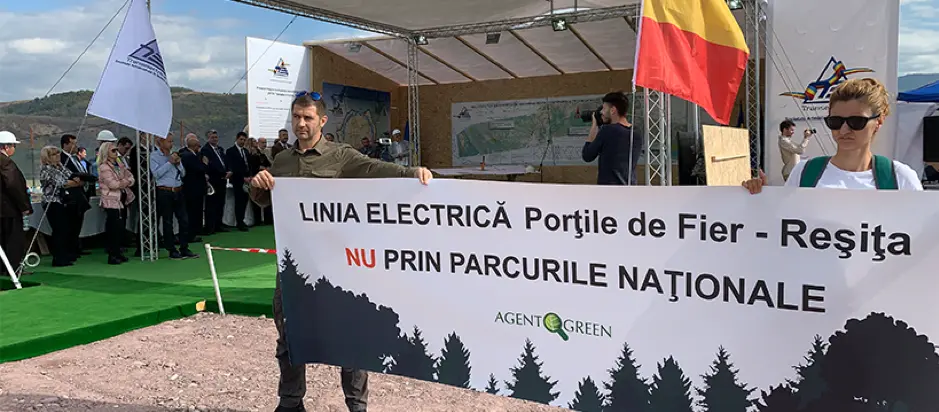
What if this project had started from the premise that protected natural areas would not be destroyed? What if, at the inauguration of the Porțile de Fier–Reșița overhead line in September 2019, Transelectrica’s director had proudly announced: we will not cut down a single tree in protected areas? Unfortunately, we cannot turn back time.