Romania shelters most of temperate Europe’s remaining primary and near-primary forests — ecosystems of inestimable value for biodiversity, the climate and Europe’s natural heritage. Yet the process of protecting these forests has been marked by delays, administrative obstacles and irreversible losses.
Where we stand today
The National Catalogue of Virgin and Quasi-Virgin Forests, the official protection instrument, has developed slowly and inadequately compared with actual conservation needs.
•The area included in the Catalogue has grown in recent years, exceeding approximately 70,000 hectares
•Scientific estimates indicate the existence of hundreds of thousands of hectares of forests with primary or near-primary characteristics
•The original target from 1999 — 400,000 hectares under strict protection — remains far from being achieved
Meanwhile, through its Biodiversity Strategy for 2030, the European Union has established an obligation of strict protection for at least 10% of the land area, including all primary and old-growth forests. Romania has yet to meet this obligation in either quality or quantity.
400,000 ha
Proposed for strict protection in 1999
~70,000 ha
Included in the Catalogue today — under 18%
See also the Romania’s Living Backbone campaign for the wider context of forest destruction in Romania.
Timeline of an administrative failure
1999 — The first major commitment
The National Sustainable Development Strategy proposes protecting 400,000 ha of primary forests.
2016 — Creation of the National Catalogue
The official mechanism for identifying and protecting primary and near-primary forests is established.
2016–2021 — Obstacles and losses
• NGOs and independent experts identify and document tens of thousands of hectares
• 24,260 ha are officially proposed for inclusion
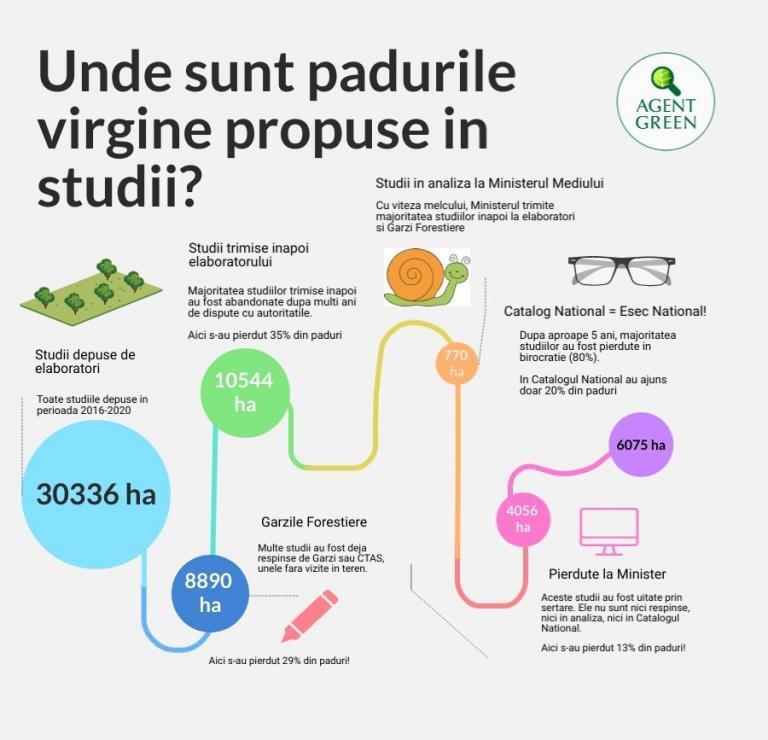
• Most studies are rejected, returned, administratively blocked or even lost
The most serious documented cases:
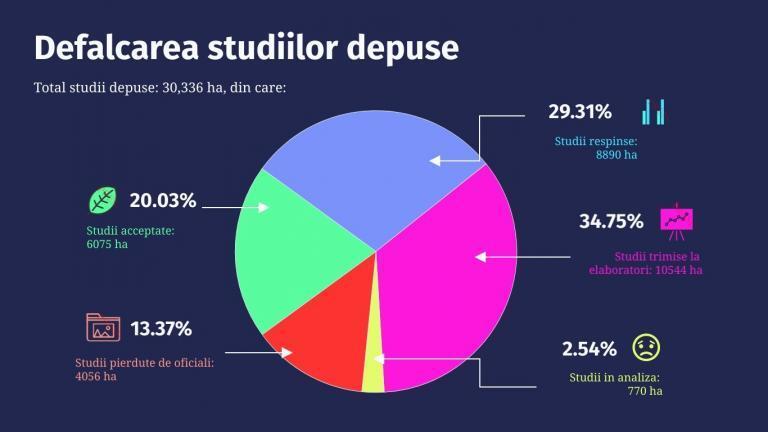
✗8,890 ha rejected outright
✗10,543 ha returned
✗more than 4,000 ha “disappeared” from institutional records
2021–present — Slow progress, European pressure
• The protected area grows, but at an insufficient pace
• Romania faces EU infringement proceedings for illegal logging and forest degradation in Natura 2000 sites
• Pressure grows for complete mapping of primary forests and automatic protection, rather than bureaucracy
Where are the primary forests proposed in studies? — Agent Green infographic
The systemic problem: bureaucracy that destroys forests
The process of inclusion in the Catalogue remains slow, opaque and vulnerable to institutional obstruction.
In the past, official data supplied by institutions were contradictory:
~9,300 ha
Ministry of Environment: hectares analysed
~24,000 ha
Forest Guards: hectares documented
This discrepancy has never been fully explained. Meanwhile, forests identified for protection continued to be logged.
The real cost: forests lost forever
In many cases, delayed protection led directly to:
logging in scientifically documented areas
fragmentation of intact ecosystems
loss of unique biodiversity
The example of the forests in Colții Bâlei remains emblematic:
initially accepted for inclusion
later removed from records
meanwhile, affected by logging
Breakdown of submitted studies: of 30,336 ha, only 20% were accepted — Agent Green infographic
Agent Green’s voice
“This failure is no accident. It is the direct result of a lack of political will. Europe’s last intact forests are disappearing before our eyes.”
“Too few forests have been protected, and many of those only following public pressure and our direct interventions on the ground.”
The European context: clear obligations, poor results
Romania has firm obligations:
•protect primary forests under the EU Biodiversity Strategy
•comply with Natura 2000 legislation
•halt biodiversity loss by 2030
Nevertheless, implementation is delayed, protection is incomplete and logging continues even in sensitive areas.
What must be done urgently
Agent Green calls for:
1
Immediate protection
All identified primary forests must be protected automatically, without prolonged bureaucratic procedures.
2
A complete inventory
Transparent nationwide mapping and involvement of the independent scientific community.
3
Stop logging
A moratorium on logging in high-value forests, real inspections and penalties.
4
Alignment with EU goals
Achieve the threshold of 10% strict protection and make a real contribution to climate and biodiversity goals.
Romania has a unique responsibility in Europe: protecting the last primary forests in the temperate zone.
Every year of delay means hectares lost, ecosystems destroyed and opportunities missed.
Protecting these forests is no longer an option. It is an emergency.