Romania without GMOs. The story of a victory. The stakes of a new fight.
✗ In 2002, Romania was completely out of control when it came to genetically modified organisms
✗ Soy, maize, potatoes, rapeseed, sunflowers and even genetically modified fruit trees — cultivated without transparency
✗ No certified laboratory in Romania for GMO testing at that time
✗ No real oversight by the authorities of genetically modified crops
Gabriel Păun, who represented Greenpeace at the time, decided to change this. That change continued with Agent Green from 2009.
We began by testing what nobody was checking. We used advanced laboratory methods, including PCR tests, and uncovered the reality in the fields and food chain. We took samples abroad — Romania had no certified laboratory.
We brought the evidence before the public. We exposed the problem. We applied pressure. And we won.
What we changed in Romania
Our campaign led to concrete transformations:
1
Strict GMO regulations
Introducing a legislative framework regulating the cultivation and marketing of genetically modified organisms in Romania.
2
Decontaminating agricultural crops
Romania abandoned large-scale GMO cultivation, becoming an example at European level.
3
Mandatory labelling
Products containing GMOs must be labelled, giving consumers the right to make informed choices.
4
The first GMO-free restaurants
Creating a model of public catering free from genetically modified organisms.
5
Removing GMOs from supermarkets
Genetically modified products were withdrawn from major Romanian retailers’ shelves.
6
Changing producers’ behaviour
Producers and retailers adapted their practices to meet demand for GMO-free products.
Danube Soy (Donau Soja) — the practical solution
We helped launch the Danube Soy initiative — a network of farmers in the Danube region growing non-genetically modified soy.
✓ It reduces Europe’s dependence on imports from deforested areas (such as the Amazon)
✓ It supports local agriculture and offers a clean alternative for industry and consumers
✓ The model works today across Europe
Why we continued monitoring
Even after this victory, we remained vigilant. For years, we independently tested agricultural crops and shop products.
In 2019, we again discovered genetically modified soy in Romania, in the Tulcea area — old seeds used illegally, together with non-selective herbicides such as glyphosate. This confirmed something essential: without constant monitoring, the problem returns.
Investigation: GMO soy in Ukraine
To protect Romania from contamination from neighbouring Ukraine, which has not yet sufficiently regulated GMOs, Agent Green took soy samples in 6 Ukrainian regions where more than half of the country’s soy harvest is grown (Poltava, Khmelnytskyi, Kyiv, Kirovohrad, Zhytomyr and Vinnytsia), to test for genetically modified organisms. Investigators took 60 samples (10 from each region) from large soy crops. 29 samples tested positive for genetically modified organisms (GMOs), which is illegal in Ukraine because every variety must be entered in the State Register, and genetically modified soy is not registered there. Ukraine grows Europe’s largest area of soy (2 million hectares annually), and exports soybeans or meal worth 1 billion euros each year worldwide, including to the EU and Romania.
Our position on science
We do not oppose scientific progress. But genetically modified organisms are created in laboratories and introduce changes that do not occur naturally.
Their long-term impact on the environment and health remains insufficiently understood. That is why we believe in the precautionary principle.
The new generation of GMOs: less visible, riskier
Today, we face a new threat: gene-edited organisms, created through techniques such as CRISPR/Cas9.
What makes them different?
✗ They force the inheritance of a genetic modification in almost all offspring
✗ They spread modifications through wild populations, beyond any control
✗ They can alter or eliminate entire species — a “forced inheritance” that does not exist in nature
Real risks that are difficult to control
1
They cannot be controlled
Once released into nature, gene-edited organisms can spread across borders through wind, water or other species.
2
They are irreversible
Genetic changes pass from generation to generation. There is no reliable way to stop them or withdraw them completely.
3
Unpredictable effects on ecosystems
Changes can affect entire chains in nature — from insects to plants and animals — with consequences that are impossible to foresee.
4
Crossing natural boundaries
Modified genes can reach other species, triggering chain reactions in ecosystems.
Where their use is proposed
Gene-edited organisms are already proposed for eliminating disease-carrying mosquitoes, controlling invasive species and agriculture. But these interventions are not isolated experiments — they can change entire ecosystems.
The real problem: a lack of regulation
Pressure to deregulate new GMOs
✗ Without real assessment of environmental and health risks
✗ Without labelling — consumers would not know what they are buying
✗ Without the right to choose — precisely the lessons of the past are being ignored
What we demand
1
Maintain and strengthen regulations
New GMOs must be subject to the same strict rules as traditional genetically modified organisms.
2
Apply the precautionary principle
No environmental release without strong evidence of long-term safety.
3
Independent testing and assessment
Risk assessment must be carried out by independent bodies, rather than the companies developing these technologies.
4
Full transparency and labelling
Consumers have the right to know what they eat and to choose GMO-free products.
5
Genuine public debate
Decisions about the future of food and biodiversity must not be taken behind closed doors.
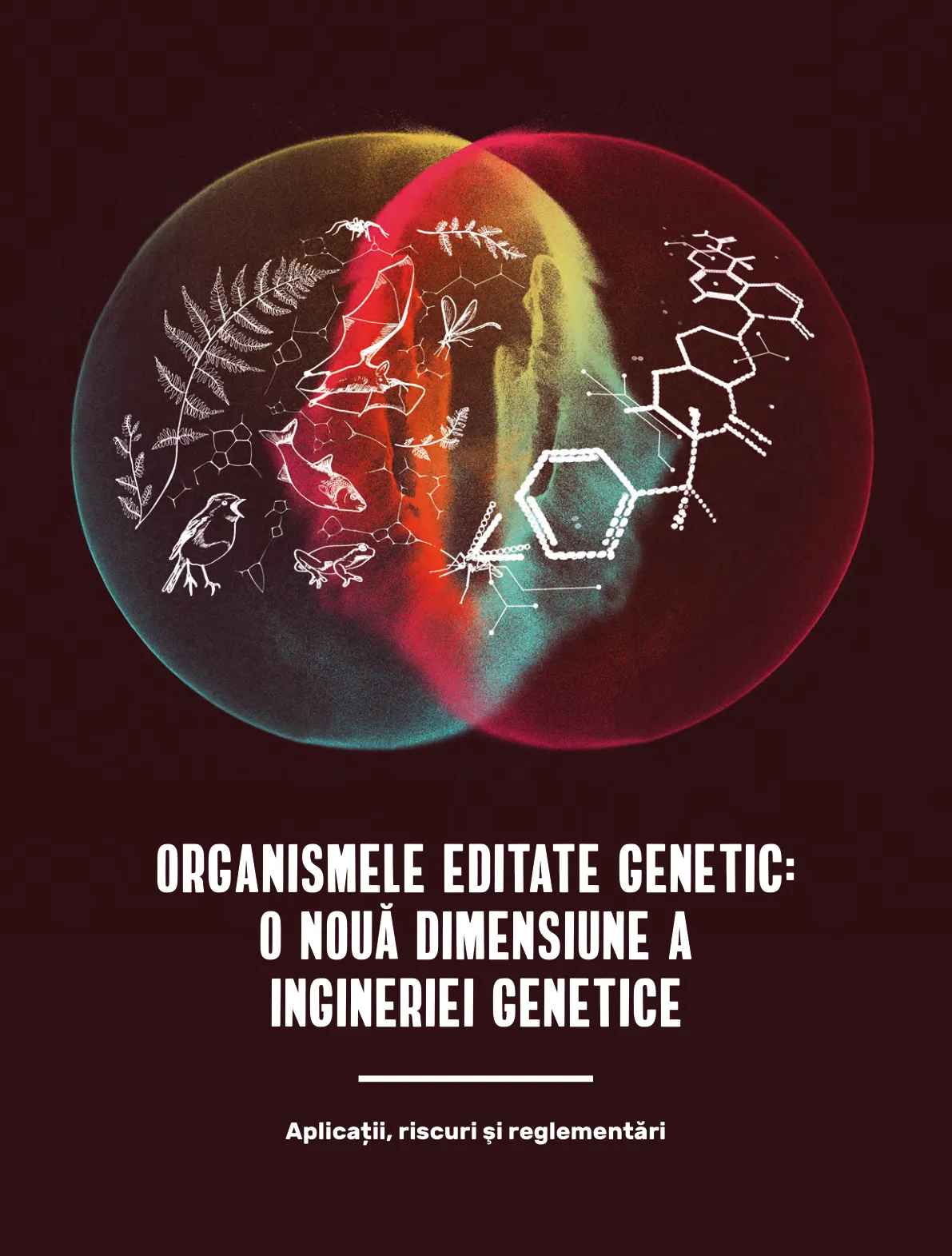
Brochure: Gene-Edited Organisms
Change is possible
This fight is about more than agriculture. It is about our health, nature’s future and the right to know what we eat.
Join Agent Green’s campaign to protect Romania and Europe from the risks of new GMOs. We have already shown it can be done.