Agent Green, Declic and Greenpeace: IFN-III results show the accelerating degradation of Romania’s forests
Agent Green, Declic and Greenpeace Romania:
IFN-III results show the accelerating degradation of Romania’s forests
Bucharest, 9 December 2025 – Agent Green, together with Greenpeace Romania and Declic, expresses deep concern over the results of the third cycle of the National Forest Inventory (IFN-III). Although the report indicates a reduction in illegal logging compared with the previous cycle, albeit an insufficient one, the data show systemic forest degradation.
Apparently positive indicators conceal major structural problems
IFN-III reports an increase in forested area of approximately 500,000 ha and an average growth rate of 8.5 cubic metres/year/ha — almost twice the European average. Some rushed to present these figures as evidence of a “healthy” or “recovering” forest. In reality, the NGOs say, they conceal an alarming development: forests that are increasingly young, sparse and exposed.
Agent Green president Gabriel Păun explains:
“The forested area has not increased because trees were planted, but because tree seeds reached arable land left uncultivated since the Revolution, and nature took its course. The billion euros we obtained through intense negotiations under Romania’s National Recovery and Resilience Plan for afforestation is blocked by Romanian bureaucracy. Almost nothing is being planted. On the contrary, arable land forested free of charge by nature is being cleared because subsidies flow more easily there.”
Păun also highlights the accelerating degradation of the age structure:
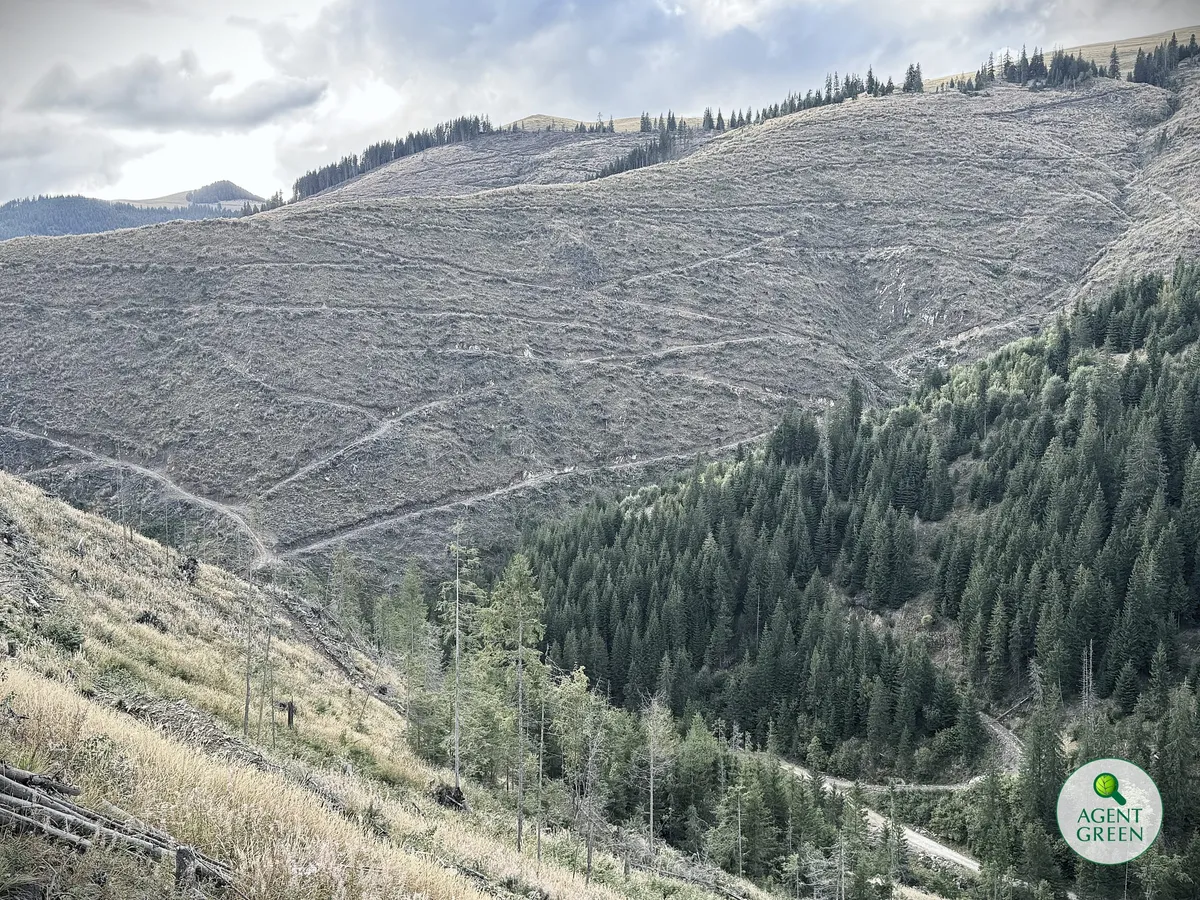
“Logging has been so irresponsible since 2000 that more than 90% of Romania’s forests are now younger than 120 years, and over 70% are under 80 years old. The high growth rate is not a sign of health. It is the sign of a forest forced to recover constantly after aggressive logging.”
Timber volume per hectare is far below the threshold needed for climate resilience
The average timber volume reported by IFN-III is 347 cubic metres/ha, whereas in a virgin forest it reaches 1500 cubic metres/ha. To be climate-resilient, a forest must retain at least 70% of its natural volume — at least 1050 cubic metres/ha in Romania. Viewed this way, the country’s forests contain just 22% of the timber needed for an ecologically functional forest.
Illegal logging remains at a critical level
IFN-III estimates that a total of 29.1 million cubic metres of timber disappears annually, of which only 18 million cubic metres are covered by documents. The missing 11 million cubic metres represent losses of at least €1.1 billion/year using an average of €100/cubic metre, without considering timber assortments that can reach €1000/cubic metre.
This is indeed a reduction from 38.6 million m3/year in IFN-II, largely thanks to the unceasing efforts of NGOs and journalists who forced the authorities to strengthen legislation and its enforcement. Yet the volume remains unacceptable, particularly since even the 18 million m3/year with paperwork do not come from sustainable logging, which is why the European Commission launched a series of necessary infringement proceedings in 2020 following formal complaints by Agent Green, Client Earth and EuroNatur.
The loss of the last old forests and pressure from industry
Less than 10% of Romania’s forests are older than 120 years — precisely those most valuable for biodiversity and climate resilience. These forests are currently targeted by aggressive logging, while the remaining areas, far too young, cannot sustain ecosystem stability in the long term.
A recent report by Agent Green, EIA and EuroNatur (PDF, in English) shows that 4.7 million cubic metres of timber were logged in the past two years from primary and old-growth forests alone, which consequently lost their status as candidates for strict protection. The missing volume would fill an unbroken line of trucks from Bucharest to Brussels.
The National Forest Inventory – an essential instrument threatened in the past
Valentin Sălăgeanu of Greenpeace Romania draws attention to the vulnerability of this fundamental instrument:
“The National Forest Inventory is a public good, defended by civil society when it was in danger of being abandoned under pressure from the forestry sector. Why did it have to disappear? Because they do not like the fact that it exposes the true scale of the disaster. From the inventory we learned that millions of cubic metres of timber are illegally cut each year, while official statistics recorded a combined total of no more than 2–300,000 cubic metres. From the inventory we learned that ecologically valuable forests are disappearing because of illegal, irrational and immoral logging.”
He adds:
“This new cycle shows us that so far the Ministry of Environment, Waters and Forests, inspection bodies, the justice system, industry, managers and owners have done too little to improve forest quality, expand forest area and eradicate illegal logging.”
Delayed technology and the failure to modernize forest protection
Antoniu Bumb of Declic stresses the need to accelerate the modernization of monitoring systems:
“For over 5 years, the Declic community has been calling on the Environment Ministry to bring forest protection into the third millennium. Although European funds are available for satellite monitoring of logging and video monitoring of timber transport, we are witnessing the constant postponement of these systems becoming a reality. Until forests are protected using modern technologies, ‘missing’ timber will remain an alarming share of everything extracted.”
Request to the Environment Ministry
The signatory organizations ask that IFN-III data be treated responsibly and that a close-to-nature forestry model be urgently implemented to ensure:
- the elimination of clear-cutting and operations that open up the canopy extensively,
- the retention of standing timber volume at a minimum of 70% of the natural level,
- immediate protection of the last mature forests, including their inclusion in the target of 10% strictly protected ecosystems under the European Biodiversity Strategy,
- forest management for climate resilience and long-term protection, rather than quick profit.
- Urgent implementation, both in SUMAL and publicly in Inspectorul Pădurii, of satellite forest monitoring and video monitoring of timber transport.
“Romania can no longer afford aggressive forestry. We need profound systemic change, guided by science and the public interest in the face of an unprecedented threat: climate change,” the organizations say.
Press contacts:
Antoniu Bumb, Declic Community. antoniu@declic.ro
Gabriel Paun, Agent Green, office@agentgreen.org
Valentin Sălăgeanu, Greenpeace Romania, valentin.salageanu@greenpeace.org
Related articles

Agent Green strengthens its team with a gendarme as it celebrates 17 years of work
Agent Green's requests for the new Forest Code